Annual grade crossing coverage: At the intersection of function and protection
Compiled by Jeff Stagl, Managing Editor
In December, BNSF Railway marked the 7,000th grade crossing it had closed across its network since 2000.
The crossing closed on McKinley Street in Corona, California, is located along the Class I’s busy Southern Transcon route between Los Angeles and Chicago and was the site of many collisions and trespassing incidents over the years.
“At BNSF, we believe the safest crossing is a closed crossing,” BNSF officials wrote in a social media post. “Every day, we partner with communities to build safer infrastructure.”
But it’s impossible to close every crossing. Since there are tens of thousands of crossings in the United States, railroads need to make them as safe as possible to help prevent accidents and incidents. So, they often turn to the supply community for ways to make crossing protection equipment more precise and more reliable.
To learn about the latest crossing products and services — including any recent innovations or enhanced offerings — Progressive Railroading reached out to a number of suppliers and service providers. Following is information collected by email from five of them.
Oculus Rail
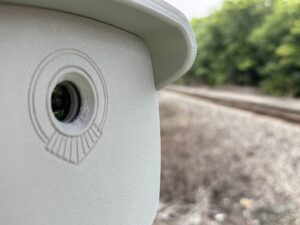
Oculus Rail is a newly launched grade crossing monitoring service designed to provide communities real-time, objective data on blocked rail crossings — something that has never been available at scale in the United States, company officials said.
Oculus Rail’s AI-enabled sensors are designed to detect exactly when a train enters and clears a roadway, capturing precise blockage durations and time-stamped images for municipalities. Deployment is fast, simple and affordable because the sensors are fully wireless and solar-powered, avoiding the cost and delay of trenching or running power or fiber-optic cables, company officials said. The sensors are installed in the public right of way, so no railroad approvals are required.
The data feeds both a free mobile app for motorists and a paid customer dashboard that provides analytics for emergency routing, traffic operations and federal grant justification. Oculus Rail also offers integrated APIs so cities, public safety departments, DOTs and railroads can incorporate the company’s data directly into their existing systems.
In 2025, Oculus Rail deployed its first network of 40 sensors across four cities in Hampton Roads, Virginia — Norfolk, Chesapeake, Suffolk and Portsmouth — creating one of the most comprehensive municipal datasets on blocked grade crossings in the country, company officials said.
Early insights have already revealed delays and patterns that were previously undocumented, and thousands of motorists are using the app notifications to help them avoid long waits at blocked crossings, they said.
Looking ahead, demand is strong. Blocked crossings are a top concern for local, state and federal leaders, yet no reliable, scalable data source has existed until now, Oculus Rail officials said.
The company’s low-cost annual data subscription provides an accessible way to quantify real-world impacts and support smarter, safer transportation planning while easing the frustration of motorists, they said.
